
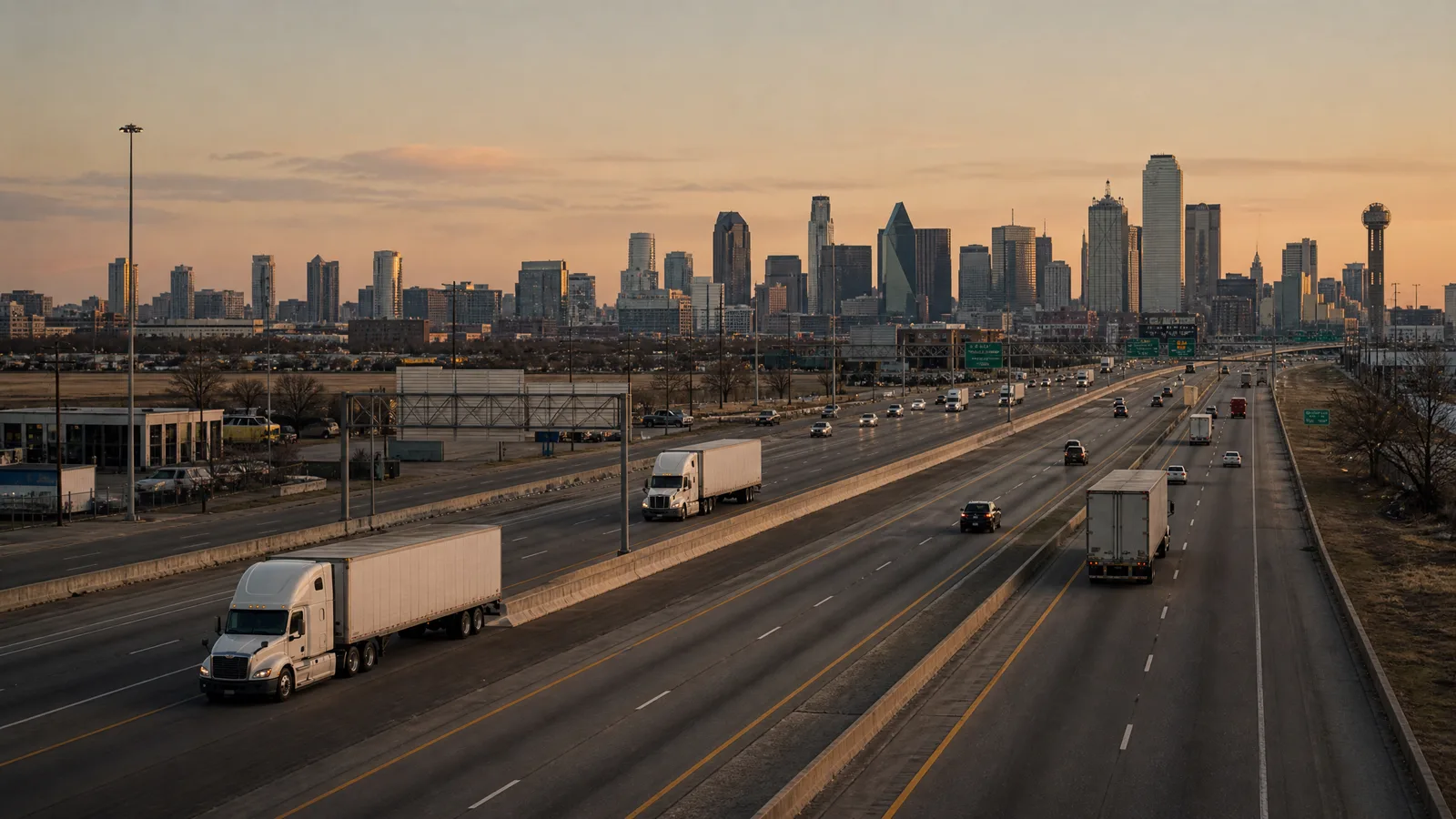
What Makes the DFW Market Different
Dallas-Fort Worth is one of the largest inland distribution hubs in the United States. Major retailers, e-commerce platforms, and third-party logistics companies operate distribution centers across the metroplex because of its central location, freeway network, intermodal infrastructure, and access to the rest of Texas and the Midwest. Commercial trucking in DFW reflects that scale: thousands of dry van, box truck, last-mile, intermodal, and construction operators based in or running through the metro.
Dallas commercial trucking insurance is the same product set as anywhere else (auto liability, cargo, physical damage, general liability, and so on), but the specific demands of the DFW market shape what operators here typically need. Hail exposure raises physical damage premiums. Major retailer contracts often dictate higher liability limits. Construction boom and ongoing TxDOT projects keep dump truck demand steady. This page covers what makes Dallas different and what operators here typically carry.
The Trucking Industry in Dallas-Fort Worth
DFW commercial trucking is anchored by several distinct freight segments:
- Distribution and warehousing. The DFW metro carries one of the largest concentrations of distribution center square footage in the country. Amazon, Walmart, Costco, Home Depot, Target, and dozens of smaller retailers operate DCs across the metroplex. Dry van operators move freight in, around, and out of these facilities.
- Intermodal. The BNSF Alliance Intermodal Facility north of Fort Worth is one of the largest inland intermodal terminals in the country. Union Pacific operates the Dallas Intermodal Terminal in southwest Dallas. Intermodal drayage operators move containers between rail terminals and customer DCs.
- Last-mile and middle-mile delivery. Box trucks, Sprinter vans, and step vans deliver from regional distribution centers to homes, businesses, and cross-dock facilities. Amazon DSP operators, FedEx Ground contractors, and independent last-mile operators all run heavily in DFW.
- I-35, I-30, I-20, and I-45 corridor freight. I-35 connects Laredo to Oklahoma and the Midwest. I-30 connects to Arkansas and the Southeast. I-20 connects East Texas, Louisiana, and Atlanta. I-45 connects Houston. DFW operators often run multiple corridors as part of normal operations.
- Construction trucking. The DFW metro is one of the fastest-growing regions in Texas. Year-round residential, commercial, and infrastructure construction sustains demand for dump trucks, flatbeds, concrete trucks, and equipment haulers.
- Owner-operator concentration. DFW has one of the largest owner-operator populations in Texas. Dispatch and brokerage operations based in the metro create steady demand for both leased operators and own-authority drivers.
Insurance Requirements for Dallas Operators
Dallas operators are subject to the same federal and Texas state insurance requirements as any other Texas-based motor carrier. The basics:
- FMCSA minimums for interstate. $750,000 for general freight, $1 million for oil transport, and $5 million for hazardous materials in 49 CFR 387.9.
- Texas intrastate minimums. $500,000 combined single limit for general freight under TxDMV rule 43 TAC 218.16.
- Cargo insurance. No federal minimum for general freight; brokers and shippers typically require $100,000 minimum.
- BMC-91 filing required for own-authority interstate. See our new authority insurance guide.
For the full breakdown, see the Texas truck insurance requirements guide.
Coverage for Dallas Operators
Beyond the basics, DFW operators typically carry coverage tuned to local market conditions:
- Higher liability limits to satisfy shipper contracts. Major retailers and 3PLs often require $1 million primary plus $2 million umbrella. Some require $5 million in total liability.
- Physical damage with hail-aware comprehensive. DFW is in one of the highest hail-loss zones in the country. Many operators carry comprehensive with separate hail deductibles or covered parking discounts.
- Cargo coverage tuned to commodity mix. Distribution operators often haul electronics, alcohol, pharmaceuticals, and other high-value commodities through DFW. Cargo limits of $250,000 to $500,000 are common for high-value runs.
- General liability for warehouse and dock operations. Operators who load, unload, or briefly store cargo at customer sites carry general liability to cover non-driving incidents (slip-and-fall, dock damage, employee-on-customer injuries).
- Hired and non-owned auto. Brokerage operators, dispatch companies, and operators who use trip-leases carry this to cover vehicles they do not own.
- Trailer interchange coverage. Operators who pull trailers owned by other carriers (common in dropbox and pool trailer arrangements) need trailer interchange to cover physical damage to those trailers in their care.
- Workers compensation. Texas does not require it, but most major shippers and 3PLs do. Most DFW fleet operators carry it.
Insurance Cost Considerations in Dallas
DFW commercial trucking insurance tends to run close to the Texas state average, with a few drivers pushing rates up:
- Hail loss frequency. North Texas is a hail belt. Major hail events in 2016, 2019, and 2023 produced large commercial vehicle losses. Physical damage and comprehensive premiums reflect this.
- Traffic density. The DFW metro freeway network produces more accident exposure than rural Texas. Liability rates reflect higher claim frequency.
- Distribution-related claim patterns. Dock incidents, trailer damage, and cargo claims at distribution centers happen at higher rates than over-the-road operations. Operators who run dock-to-dock and last-mile see claim patterns specific to those operations.
- Construction and ongoing infrastructure work. TxDOT highway expansion projects across the metro create temporary lane configurations and detours that produce more accidents.
For specific cost ranges by truck type and operator size, see our commercial truck insurance cost guide.
How to Get Dallas Trucking Insurance Quotes
The DFW commercial trucking insurance market has dozens of agents and access to most major commercial trucking carriers. The right agent depends on your operation. Distribution operators want agents who handle major-shipper insurance requirements. Last-mile operators want agents who write Amazon DSP, FedEx Ground, and similar contractor programs. Construction operators want agents who handle TxDOT subcontractor requirements and general liability.
Find an agent who serves the DFW market. Tell them what you haul, what your customers require, and where you typically run. The right agent will quote multiple carriers and find a policy that fits your operation.
Related Dallas Trucking Resources
- Texas Commercial Trucking Insurance Overview
- Texas Truck Insurance Requirements
- Box Truck Insurance (for last-mile operators)
- Dump Truck Insurance (for DFW construction haulers)
- Owner-Operator Insurance
- Fleet Insurance (for multi-truck DFW operations)